 IoT
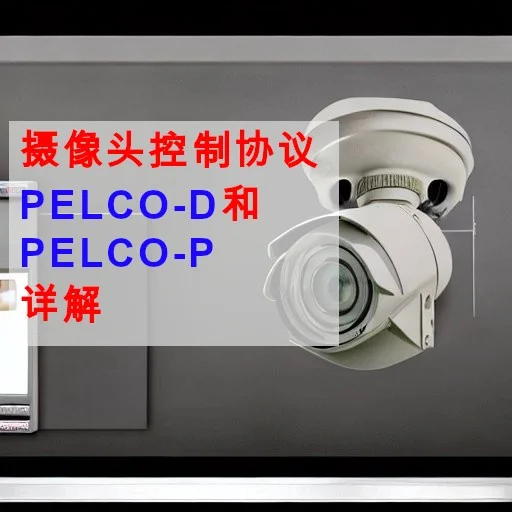
IoT Detailed Explanation of Camera Control Protocols PELCO-D and PELCO-P
1. Introduction
Closed-circuit television (CCTV) systems are widely used in security monitoring, and remote camera control is crucial for the system. PELCO-D and PELCO-P are two mainstream video transmission protocols used to transmit control commands and video signals between cameras and control devices.
PELCO-D was first proposed by Pelco in 1986 as an early serial protocol standard, mainly used for transmitting control information. PELCO-P is an improved version launched later, adding digital video transmission capabilities. These two protocols differ in transmission distance, video quality, supported control commands, and other aspects.
This article will mainly compare the PELCO-D and PELCO-P protocols from the following aspects:
-
Technical principles and implementation differences
-
Transmission distance and video quality
-
Supported control commands
-
System capacity and compatibility
-
Common application areas
Through analysis and comparison, we can more clearly understand the differences between the two protocols and provide reference for CCTV system design. The following will elaborate and compare the advantages and disadvantages of the two protocols.
2. PELCO-D Protocol
PELCO-D is a closed-circuit television camera control protocol first proposed by Pelco in 1986. It uses RS-485 serial communication and can reliably transmit control commands through a twisted pair cable.
PELCO-D uses Manchester encoding and operates at a baud rate of 2400bps. This protocol is only responsible for transmitting control signals, not video signals. It can support up to 255 camera devices, allowing operations such as jog, zoom, and preset control of cameras.
PELCO-D control commands include preset control, servo control, and image transmission control. Among them, up to 64 presets can be set, with a rotation range of 0-355 degrees and a tilt range of 0-90 degrees. It also supports 8 patrol route recordings.
The maximum transmission distance of PELCO-D is 240 meters. It is widely used in scenarios requiring long-distance control, such as universities, factories, and sports venues. PELCO-D is mature, stable, and has wide compatible equipment, making it the preferred control protocol for many early CCTV systems.
2. PELCO-D Protocol Communication Data Format
The communication data packet format of PELCO-D is as follows:
| Byte 1 | Byte 2 | Byte 3 | Byte 4 | Byte 5 | Byte 6 | Byte 7 |
|---|---|---|---|---|---|---|
| Sync Byte | Address | Command Code 1 | Command Code 2 | Data Code 1 | Data Code 2 | Checksum |
-
Byte 1 - Address code
-
Byte 2 - Command code
-
Bytes 3-7 - Data
-
Byte 8 - Checksum
-
Both use serial communication to transmit control commands
-
Both use one-way communication, with the master device (controller) sending commands to the slave device (camera)
-
Both support multiple PTZ control functions, including up/down/left/right rotation, zoom, focus, aperture control, etc.
-
Both support preset setting and calling functions
-
Both support device address configuration, allowing control of multiple cameras on the same line (up to 255)
-
Default baud rate is 9600bps
Examples of some PELCO-D control commands:
| Command Code | Description |
|---|---|
| FF 01 00 08 00 FF 08 | PTZ tilt up |
| FF 01 00 10 00 FF 10 | PTZ tilt down |
| FF 01 00 04 FF 00 04 | PTZ pan left |
| FF 01 00 02 FF 00 02 | PTZ pan right |
| FF 01 00 00 00 00 01 | PTZ stop |
PELCO-D communication is very simple and reliable, which is one of the reasons it can work in poor network environments. The implementation of each control command is also relatively intuitive and easy to support by devices.
3. PELCO-P Protocol
PELCO-P is a new generation protocol launched by Pelco in 1996, with significant improvements over PELCO-D. It uses coaxial cable transmission and can simultaneously transmit control commands and video signals.
PELCO-P continues to use Manchester encoding but increases the baud rate to 9600bps. It supports traditional dome camera control while adding control for speed dome cameras. Presets are expanded to 255, and up to 80 patrol routes can be set.
PELCO-P video transmission supports CVBS and Y/C formats, with transmission distances up to 500 meters. It also implements two-way communication and can return camera status information. It supports control of video PARAMETERS such as brightness, contrast, and chroma.
Additionally, PELCO-P enhances reliability using CRC checksums to verify transmission errors. It is widely used in situations requiring high-quality video transmission, such as banks, transportation, and airports. PELCO-P is powerful but has poor compatibility and higher costs.
4. Comparison
| Comparison Item | PELCO-D | PELCO-P |
|---|---|---|
| Transmission Mode | RS-485 serial line | Coaxial cable |
| Maximum Transmission Distance | 240 meters | 500 meters |
| Video Transmission | Not supported | Supports CVBS/Y/C |
| Maximum Baud Rate | 2400bps | 9600bps |
| Number of Presets | 64 | 255 |
| Number of Patrol Routes | 8 | 80 |
| Speed Dome Control | Not supported | Supported |
| CRC Error Detection | Not supported | Supported |
| Cost | Low | High |
| Compatibility | Strong | Weak |
In summary, PELCO-P is superior in functionality and performance, but PELCO-D is more widely applied due to its low cost and strong compatibility. Both have their own advantages and should be selected based on actual needs.
5. Summary
Through the above comparison, it can be seen that PELCO-D and PELCO-P each have their own advantages.
PELCO-D is an early control protocol with the advantages of low cost, simplicity, reliability, and wide compatible equipment. It meets basic remote control needs and is suitable for long-distance scenarios, making it the standard configuration for many early systems.
PELCO-P is more advanced in functionality and performance, achieving digital video transmission and supporting more advanced control functions. Suitable for application scenarios with high requirements for image quality and operation. However, it costs more and has complex equipment that requires professional debugging.
Which protocol to use needs to be balanced according to actual scenario requirements. If only basic control is needed, or the budget is limited, PELCO-D is a good choice. If pursuing high-quality video and more powerful functions, PELCO-P is more suitable. Generally speaking, PELCO-D is suitable for ordinary scenarios, while PELCO-P is suitable for high-end venues.