 Drone Technology
 DJI 4G Module Explained: How It Works + DIY Alternatives (2026)
Google Trends data shows “DJI 4G dongle” has maintained high search volume for 13 consecutive days (August 2-14, 2026), with “DJI transmission module” showing pulse-like search spikes from August 6-12. This isn’t coincidence—DJI is accelerating its cellular video transmission technology, and this article will give you a deep dive into the technology, its current state, and DIY alternatives.
What Is the DJI 4G Transmission Module?
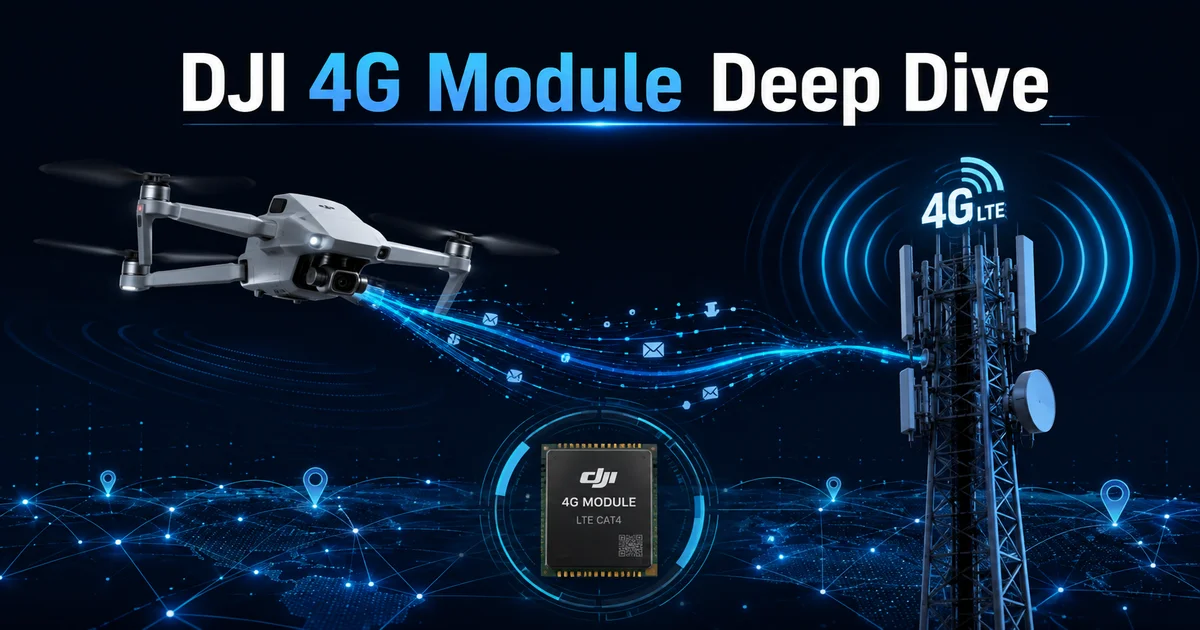
The DJI 4G transmission module (official name: DJI Cellular Dongle) is an enhanced transmission technology that combines traditional OcuSync digital video transmission with 4G LTE cellular networks. The core concept is simple: when 2.4GHz/5.8GHz frequencies are interfered with or exceed line-of-sight range, automatically switch to 4G networks to maintain video feed and control links.
Technical Principles: 4G LTE vs Traditional 2.4GHz/5.8GHz
Traditional FPV video transmission systems operate in ISM bands (2.4GHz and 5.8GHz), which have several inherent limitations:
- Severe interference: WiFi routers, Bluetooth devices, and microwaves all use the same frequencies, causing channel congestion in urban environments
- Line-of-sight limitations: Signals cannot penetrate buildings and terrain, losing connection beyond visual range
- Distance attenuation: Even without interference, power limitations (FCC specifies 2.4GHz maximum 1W) restrict range
Advantages of 4G LTE video transmission:
- Cellular network coverage: Transmission works anywhere with cell phone signal, theoretically unlimited distance
- Strong interference resistance: Uses licensed frequency bands, immune to WiFi/Bluetooth interference
- Automatic switching: Dual-link redundancy between OcuSync and 4G, with one immediately taking over if the other fails
DJI Cellular Dongle 2 workflow:
- Install 4G Dongle on the drone (insert Nano SIM card)
- Connect phone/tablet to the controller via USB-C
- The mobile app receives both OcuSync direct signal and 4G network signal simultaneously
- System automatically selects the better quality link, or fuses both signals
DJI Cellular Dongle 2: Known Specifications and Compatibility
According to DJI official documentation and community testing, key parameters for DJI Cellular Dongle 2:
| Parameter | Specification |
|---|---|
| Weight | ~25g (including SIM card slot) |
| Dimensions | 45 × 28 × 12 mm |
| Supported Networks | 4G LTE Cat.4 (150Mbps downlink, 50Mbps uplink) |
| SIM Card | Nano SIM (data plan required) |
| Compatible Models | DJI Air 3, Mini 4 Pro, Matrice 4T, Mavic 3 series |
| Operating Temperature | -10°C to 40°C |
| Power Consumption | ~2W (peak) |
| Price | ~$99-$129 USD |
Compatibility Notes
Important reminder: DJI Cellular Dongle 2 does not support DIY FPV drones or third-party flight control systems. It only works with DJI consumer and enterprise drones, and requires firmware support.
Community feedback shows:
- US users need VPN to activate (regional restrictions)
- China mainland and overseas firmware versions are incompatible
- Some users report 200-500ms 4G switching latency in dense urban areas
DJI 4G vs O4 Air Unit vs DIY Solutions Comparison
| Comparison | DJI 4G Dongle 2 | DJI O4 Air Unit | ESP32 + 4G DIY |
|---|---|---|---|
| Max Distance | Theoretically unlimited (with 4G coverage) | 15km (FCC) / 8km (CE) | Theoretically unlimited (with 4G coverage) |
| Latency | 50-200ms (4G) / 20ms (OcuSync) | 15-30ms | 100-500ms (4G) |
| Video Quality | 1080p/30fps (4G) / 1080p/100fps (OcuSync) | 1080p/100fps | 720p/30fps (limited by 4G uplink) |
| Interference Resistance | Strong (4G licensed bands) | Medium (2.4/5.8GHz ISM) | Strong (4G licensed bands) |
| Cost | $99-$129 (Dongle) + SIM data fees | $299-$499 (complete system) | $70-100 (ESP32 + EC200U) |
| Open Source | Fully closed | Fully closed | Fully open source |
| Use Cases | Beyond visual line of sight, urban environments | FPV racing, close-range aerial photography | Remote monitoring, research, custom applications |
| Learning Curve | Plug and play | Plug and play | Requires programming and hardware debugging |
DIY Alternative: ESP32 + 4G LTE Module
If you want similar functionality to DJI 4G video transmission but on a budget, or need a fully open-source solution, ESP32 + 4G LTE module is the best choice. We previously wrote a detailed 4G Cat.1 module EC200U tutorial, here we focus on drone video transmission applications.
Hardware List
- Main Controller: ESP32-WROOM-32 (~$4)
- 4G Module: EC200U-T (~$7, supports Cat.1)
- Camera: OV2640 or OV5640 (~$2-4)
- Power: 3.7V LiPo battery + 5V boost converter
- Antenna: 4G LTE omnidirectional antenna + WiFi antenna
- Total Cost: ~$15-18 USD
Wiring Diagram
ESP32-WROOM-32          EC200U-T           OV2640
┌─────────────┐        ┌──────────┐        ┌──────────┐
│         GPIO21├──────┤SDA       │        │          │
│         GPIO22├──────┤SCL       │        │          │
│         GPIO16├──────┤TXD       │        │          │
│         GPIO17├──────┤RXD       │        │          │
│          3V3  ├──────┤VCC       │        │          │
│          GND  ├──────┤GND       │        │          │
│              │        │          │        │          │
│      GPIO34-39├──────┤D0-D7     ├────────┤DVP Interface│
│      GPIO2-3  ├──────┤VSYNC/HSYNC├───────┤          │
└─────────────┘        └──────────┘        └──────────┘
Core Code Framework
#include <WiFi.h>
#include "esp_camera.h"
#include "EC200U.h"  // 4G module driver

// Camera configuration
camera_config_t config;
config.ledc_channel = LEDC_CHANNEL_0;
config.ledc_timer = LEDC_TIMER_0;
config.pin_d0 = 34;
config.pin_d1 = 35;
config.pin_d2 = 36;
config.pin_d3 = 37;
config.pin_d4 = 38;
config.pin_d5 = 39;
config.pin_d6 = 34;
config.pin_d7 = 35;
config.pin_xclk = 0;
config.pin_pclk = 1;
config.pin_vsync = 2;
config.pin_href = 3;
config.pin_pclk = 4;
config.xclk_freq_hz = 20000000;
config.pixel_format = PIXFORMAT_JPEG;
config.frame_size = FRAMESIZE_VGA;  // 640x480
config.jpeg_quality = 15;  // 0-63, lower is better quality
config.fb_count = 2;

// 4G module initialization
EC200U modem(Serial2);  // GPIO16(TX), GPIO17(RX)

void setup() {
  Serial.begin(115200);

  // Initialize camera
  esp_camera_init(&config);

  // Initialize 4G module
  modem.init();
  modem.connectLTE();

  // Establish TCP connection to ground station
  modem.connectTCP("your-server.com", 8080);
}

void loop() {
  // Capture image
  camera_fb_t *fb = esp_camera_fb_get();
  if (!fb) return;

  // Send image via 4G
  modem.sendData(fb->buf, fb->len);

  // Release frame buffer
  esp_camera_fb_return(fb);

  delay(33);  // ~30fps
}
Performance Optimization Tips
- Dynamic bitrate control: Automatically adjust JPEG quality based on 4G signal strength (lower quality when signal is weak)
- Frame skipping: Send one frame every 2-3 frames when signal is poor to avoid queue buildup
- UDP instead of TCP: Use UDP for high real-time requirements, tolerating some packet loss
- Dual-link redundancy: Use both 4G and ESP-NOW (short range) simultaneously, with automatic switching
Open Source Solution: WFB-ng + 4G Backup Link
WFB-ng (WiFi Broadcast Next Generation) is an open-source long-range digital video transmission system based on raw WiFi radio packets. Originally designed for FPV drones, it now supports adding 4G as a backup link.
WFB-ng Core Features
- Low latency: Uses raw WiFi frames, bypassing TCP/IP stack, latency < 10ms
- Long range: 30-50km with directional antennas
- Forward error correction: FEC encoding, recoverable with 30% packet loss
- IP tunneling: Supports MAVLink telemetry and SSH debugging
- Open source free: GPLv3 license
Adding 4G Backup Link
WFB-ng doesn’t natively support 4G, but can be integrated in these ways:
- Dual NIC bonding: WiFi NIC (primary) + 4G USB NIC (backup), using
bondingdriver - Application-layer switching: Detect WiFi signal quality in ground station software, switch to 4G stream when below threshold
- OpenIPC integration: Run both WFB-ng and 4G streaming simultaneously in OpenIPC-compatible cameras
Recommended Hardware Configuration
Airborne:
- Camera: RunCam Thumb Pro (OpenIPC support)
- WiFi NIC: RTL8812AU (5GHz, monitor mode support)
- 4G Module: EC25-A (Cat.4, USB interface)
- Flight Controller: Any MAVLink-compatible FC
Ground:
- Receiver: Coaxial WiFi NIC × 2 (diversity reception)
- 4G Receiver: EC25-A + omnidirectional antenna
- Display Software: QGroundControl or Mission Planner
Real-World Test Data and Performance Analysis
Based on community reports and theoretical analysis, performance of the three solutions in different scenarios:
Urban Environment (high interference, building obstruction)
| Solution | 100m | 500m | 1km | 5km | 10km+ |
|---|---|---|---|---|---|
| DJI 4G Dongle | Excellent | Excellent | Excellent | Excellent | Excellent (with 4G) |
| O4 Air Unit | Excellent | Good | Medium | Poor | Disconnected |
| ESP32 + 4G | Good | Good | Good | Excellent | Excellent (with 4G) |
| WFB-ng | Excellent | Excellent | Good | Medium | Poor |
Open Areas (farms, mountains, sea surface)
| Solution | 1km | 5km | 10km | 15km | 20km+ |
|---|---|---|---|---|---|
| DJI 4G Dongle | Excellent | Excellent | Excellent | Excellent | Depends on 4G coverage |
| O4 Air Unit | Excellent | Excellent | Good | Medium | Disconnected |
| ESP32 + 4G | Good | Good | Excellent | Excellent | Depends on 4G coverage |
| WFB-ng + Directional Antenna | Excellent | Excellent | Excellent | Good | Medium |
Latency Comparison (critical metric)
- DJI O4 Air Unit: 15-30ms (direct) / 50-200ms (4G mode)
- DJI 4G Dongle: 50-200ms (pure 4G) / 20ms (OcuSync priority)
- ESP32 + 4G: 100-500ms (limited by 4G uplink and JPEG encoding)
- WFB-ng: 5-15ms (WiFi direct) / 100-300ms (4G backup)
Conclusion: If you pursue ultimate low latency (FPV racing), O4 Air Unit or WFB-ng are the best choices; if you need beyond visual line of sight flight or urban environment reliability, 4G solutions (DJI official or DIY) have the advantage.
Cost Analysis
Entry Level (Budget < $200)
- ESP32 + EC200U DIY: $70-100 (excluding controller, flight controller)
- Suitable for: Learning, research, remote monitoring
Mid-Range (Budget $200-500)
- DJI Cellular Dongle 2: $99-129 (requires existing DJI drone)
- WFB-ng Complete System: $200-300 (including camera, NIC, antennas)
- Suitable for: FPV enthusiasts, aerial photographers
Professional (Budget > $500)
- DJI O4 Air Unit Pro: $499 (complete system)
- DJI Matrice 4T + 4G Dongle: $5000+ (enterprise grade)
- Suitable for: Commercial aerial photography, surveying, security
Future Trends and Outlook
- 5G video transmission: DJI may launch a 5G version in 2027, reducing latency to under 10ms
- AI enhancement: Using AI to predict signal quality and switch links proactively
- Open source ecosystem: WFB-ng and OpenIPC communities are developing better 4G integration solutions
- Regulatory changes: Regulatory policies on drone 4G usage in various countries will affect adoption speed
Frequently Asked Questions (FAQ)
Does DJI 4G Dongle require a SIM card?
Yes, DJI Cellular Dongle requires a Nano SIM card with 4G data plan. We recommend unlimited or large data plans (at least 10GB per month).
Can ESP32 + 4G solution be used for FPV racing?
Not recommended. ESP32 + 4G latency (100-500ms) is too high for FPV racing needs (requires < 30ms). This solution is more suitable for remote monitoring, research, or aerial photography.
Which is better, WFB-ng or DJI O4?
Depends on the use case:
- FPV racing, low latency needs: WFB-ng (5-15ms) outperforms O4 (15-30ms)
- Plug and play, reliability: DJI O4 is more mature, ready to use out of the box
- Limited budget, customization: WFB-ng is open source free, deeply customizable
Can 4G video transmission work in areas without cell phone signal?
No. 4G video transmission relies on cellular network coverage and will fail in remote mountains, at sea, or underground areas without signal. We recommend using traditional 2.4/5.8GHz video transmission or LoRa solutions in these scenarios.
Is DIY 4G video transmission legal?
In most countries, using 4G LTE modules requires compliance with local telecommunications regulations:
- Must use carrier-certified modules (e.g., EC200U, EC25)
- Must use legal SIM card with payment
- Must not interfere with public networks
- Some countries restrict drone 4G usage (check local regulations)
Summary
DJI 4G transmission module represents the future direction of drone communication—integrating traditional RF and cellular networks to achieve seamless coverage and ultra-high reliability. For regular users, DJI Cellular Dongle 2 is the simplest choice; for developers and geeks, ESP32 + 4G or WFB-ng provide greater flexibility and lower costs.
Whichever solution you choose, the key is balancing based on actual needs:
- Latency sensitive (FPV) → O4 Air Unit or WFB-ng
- Distance priority (beyond visual line of sight) → 4G solutions (DJI or DIY)
- Limited budget → ESP32 + 4G DIY
- Plug and play → DJI official solutions
With 5G adoption and open source ecosystem development, we can expect lower latency, longer range, and lower cost video transmission solutions to emerge in 2027.
Related Resources: