 ESP32
ESP32 ESP32 Introduction
Introduction
ESP32 is a series of low-cost, low-power microcontrollers with integrated Wi-Fi and dual-mode Bluetooth. The ESP32 series uses Tensilica Xtensa LX6 microprocessors, including dual-core and single-core versions, with built-in antenna switch, RF module, power amplifier, low noise receive amplifier, filters, and power management modules.
ESP32 was created and developed by Espressif Systems, a Chinese company headquartered in Shanghai, and manufactured by TSMC using 40nm process technology. It offers ultra-high RF performance, stability, versatility, and reliability, as well as ultra-low power consumption to meet various power requirements for different application scenarios. It is the successor to the ESP8266 microcontroller.
Current ESP32 series product models include ESP32-S2 (single-core + 2.4G wifi), ESP32-S3 (dual-core + 2.4G wifi + Bluetooth 5), ESP32-C2 (single-core + 2.4G wifi + Bluetooth 5), ESP32-C3 (single-core + 2.4G wifi + Bluetooth 5), and the original ESP32 module.
Features
Stable Performance
ESP32 delivers stable performance with an operating temperature range of –40°C to +125°C. Integrated self-calibration circuits achieve dynamic voltage adjustment, eliminating external circuit deficiencies and adapting to external condition changes.
Ultra-Low Power Consumption
ESP32 is designed for mobile devices, wearable electronics, and Internet of Things (IoT) applications. As an industry-leading low-power chip, ESP32 features fine clock gating, power-saving modes, and dynamic voltage adjustment. For example, in low-power IoT sensor hub application scenarios, ESP32 is only periodically woken up under specific conditions. Low duty cycles can greatly reduce ESP32 chip energy consumption. The RF power amplifier output power can also be adjusted to achieve the optimal balance between communication distance, data rate, and power consumption.
High Integration
ESP32 is an industry-leading highly integrated Wi-Fi + Bluetooth solution requiring only about 20 external components. ESP32 integrates antenna switch, RF balun, power amplifier, low noise amplifier, filters, and power management module, greatly reducing printed circuit board (PCB) area. ESP32 uses CMOS technology for single-chip integration of RF and baseband, and also integrates advanced self-calibration circuits for dynamic automatic adjustment, eliminating external circuit deficiencies and better adapting to external environment changes. Therefore, ESP32 mass production doesn’t require expensive dedicated Wi-Fi test equipment.
Wi-Fi and Bluetooth Solutions
ESP32 can operate as a standalone system running applications or as a slave to a host MCU, providing Wi-Fi and Bluetooth functionality through SPI/SDIO or I2C/UART interfaces.
Series Comparison
Let’s first look at descriptions of different modules:
ESP32-S2 Series
32-bit MCU & 2.4 GHz Wi-Fi

-
Integrated ESP32-S2 chip, Xtensa® 32-bit LX7 single-core processor, clock frequency up to 240 MHz
-
Supports multiple low-power working states: fine clock gating, dynamic voltage clock frequency adjustment
-
Security mechanisms: eFuse storage, secure boot, Flash encryption, digital signature, supports AES, SHA, and RSA algorithms
-
Peripherals include 43 GPIO pins, 1 full-speed USB OTG interface, SPI, I2S, UART, I2C, LED PWM, LCD interface, Camera interface, ADC, DAC, touch sensor
-
Can connect to rich network cloud platforms with universal product features, greatly shortening product development and time-to-market
-
Certified by RF and software protocol certifications
ESP32-S3 Series
32-bit MCU & 2.4 GHz Wi-Fi & Bluetooth 5 (LE)

-
Xtensa® 32-bit LX7 dual-core processor, main frequency up to 240 MHz
-
Built-in 512 KB SRAM, 384 KB ROM storage space, supports multiple external SPI, Dual SPI, Quad SPI, Octal SPI, QPI, OPI flash and off-chip RAM
-
Additional vector instructions for accelerating neural network computing and signal processing
-
45 programmable GPIOs, supporting common peripheral interfaces such as SPI, I2S, I2C, PWM, RMT, ADC, DAC, UART, SD/MMC host controller, and TWAI™ controller
-
AES-XTS algorithm-based Flash encryption and RSA algorithm-based secure boot, digital signature and HMAC modules, “World Controller” module
-
Certified by RF and software protocol certifications
-
Below is the ESP32-S3 series chip comparison. SiP flash and SiP PSRAM refer to flash and PSRAM packaged inside the chip. Octal SPI uses 5 more GPIOs than Quad SPI, namely GPIO33 ∼ GPIO37.
| Model | SiP flash | SiP PSRAM | Operating Temp (°C) | SPI Voltage |
|---|---|---|---|---|
| ESP32-S3 | - | - | –40 ∼ 105 | 3.3 V/1.8 V |
| ESP32-S3FN8 | 8 MB (Quad SPI) | - | –40 ∼ 85 | 3.3 V |
| ESP32-S3R2 | - | 2 MB (Quad SPI) | –40 ∼ 85 | 3.3 V |
| ESP32-S3R8 | - | 8 MB (Octal SPI) | –40 ∼ 85 | 3.3 V |
| ESP32-S3R8V | - | 8 MB (Octal SPI) | –40 ∼ 65 | 1.8 V |
ESP32-C2 Series
32-bit RISC-V MCU & 2.4 GHz Wi-Fi & Bluetooth 5 (LE)

-
RISC-V 32-bit single-core processor, main frequency up to 120 MHz
-
Industry-leading low-power performance and RF performance
-
Built-in 272 KB SRAM (16 KB dedicated to cache), 576 KB ROM storage space
-
14 programmable GPIOs, supporting common peripheral interfaces such as SPI, UART, I2C, LED PWM, and DMA
-
Certified by RF and software protocol certifications
ESP32-C3 Series
32-bit RISC-V MCU & 2.4 GHz Wi-Fi & Bluetooth 5 (LE)

-
Integrated ESP32-C3 chip, RISC-V 32-bit single-core processor, clock frequency up to 160 MHz
-
Industry-leading low-power performance and RF performance
-
Built-in 400 KB SRAM, 384 KB ROM storage space, supports multiple external SPI, Dual SPI, Quad SPI, QPI flash
-
Comprehensive security mechanisms: RSA-3072 algorithm-based secure boot, AES-128-XTS algorithm-based flash encryption, innovative digital signature and HMAC modules, hardware accelerator supporting encryption algorithms
-
Rich communication interfaces and GPIO pins, supporting multiple scenarios and complex applications
-
Certified by RF and software protocol certifications
ESP32 Series
32-bit MCU & 2.4 GHz Wi-Fi & Bluetooth/Bluetooth LE
-
Integrated ESP32 series chips, two or one independently controllable Xtensa® 32-bit LX6 processors, adjustable clock frequency ranging from 80 MHz to 240 MHz
-
+19.5 dBm antenna output power ensures good coverage
-
Classic Bluetooth supports L2CAP, SDP, GAP, SMP, AVDTP, AVCTP, A2DP (SNK), and AVRCP (CT) protocols
-
Bluetooth Low Energy (BLE) supports L2CAP, GAP, GATT, SMP, and BluFi over GATT, SPP-like protocols, etc.
-
BLE connects to smartphones, sends low-power beacons for easy detection
-
Sleep current less than 5 μA, suitable for battery-powered wearable devices
-
Peripherals include capacitive touch sensors, Hall sensors, SD card interface, Ethernet, high-speed SPI, UART, I2S, and I2C
-
Certified by RF and software protocol certifications
Development Boards
ESP32-DevKitC
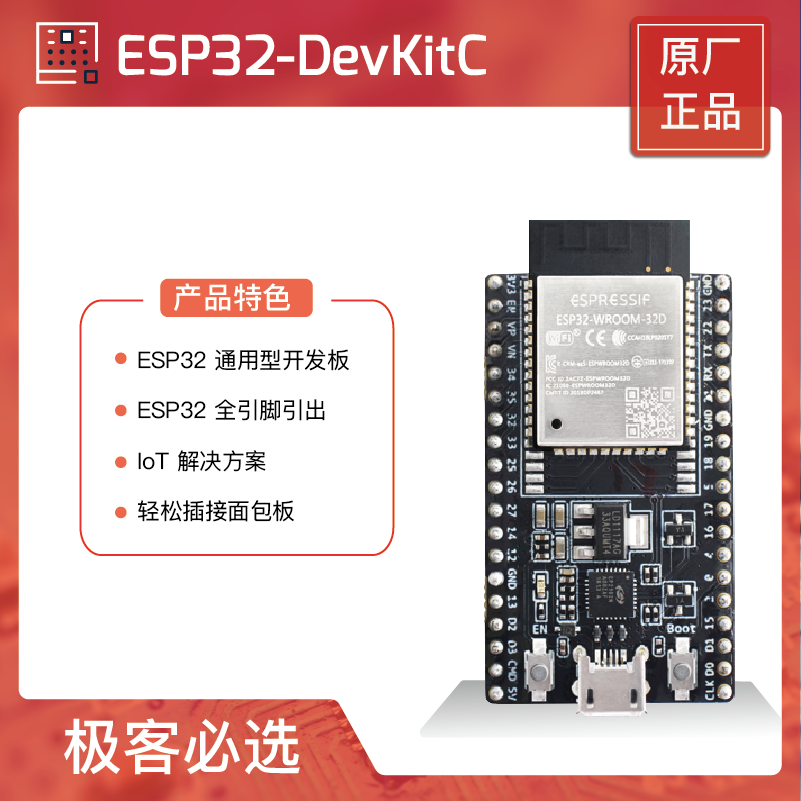 This is Espressif’s own development board product. It’s expensive, typically priced between 68 and 88 yuan, but quality is guaranteed.
NodeMCU ESP32
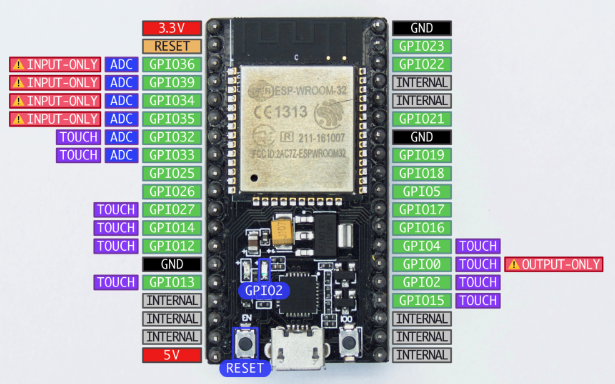 NodeMCU, also known as AI-Thinker in some places, is a series of development board products developed by Shenzhen Ai-Thinker Technology Co., Ltd. based on Espressif’s ESP32 low-power UART-WiFi chip modules. Typically priced at 20-30 yuan, quality is also good.