 IoT
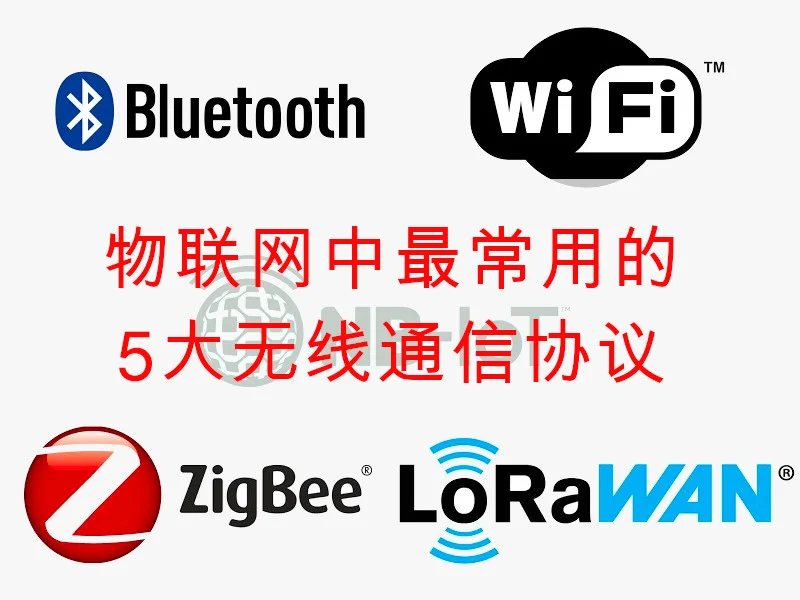
IoT Top 5 Most Common Wireless Communication Protocols in IoT
Today I’ll discuss the 10 most widely used wireless communication protocols in the IoT field.
The rapid development of IoT has made our lives more convenient, but the emergence of various wireless communication protocols also brings considerable trouble to product selection. Below, I’ll introduce in detail the 10 most important wireless communication technologies in the current IoT field, ranked by usage frequency from high to low.
1. Bluetooth/BLE
 Bluetooth is a short-distance, low-power wireless connection technology, mainly used to connect fixed devices and mobile devices. Its main advantages include:
-
Low power consumption: Compared to WiFi, Bluetooth is more energy-efficient, especially BLE (Bluetooth Low Energy) version, which can achieve ultra-long standby time. This makes it very suitable for wearable devices and IoT sensors.
-
Low cost: Bluetooth hardware costs are very low and it’s already built into most smart devices. This also helps reduce overall device costs.
-
Easy to connect: Connections between Bluetooth devices are simple and quick, usually requiring just one click to enable Bluetooth to establish a connection.
-
Strong anti-interference capability: Bluetooth uses spread spectrum technology, effectively resisting environmental noise interference.
-
Complete standard specifications: Bluetooth technology is uniformly managed by the Bluetooth SIG organization, ensuring compatibility between devices from different manufacturers.
-
Diverse device types: From headphones to speakers, from watches to lighting, various terminal devices can be connected via Bluetooth.
Bluetooth technology also has some disadvantages:
-
Limited transmission distance: Bluetooth’s effective transmission distance is generally only 10-100 meters. This may not be enough for applications requiring long-distance connections.
-
Slow transmission speed: Classic Bluetooth speed is only 1-3Mbps, and BLE is only 1Mbps, unable to transmit high-speed content like video streams.
-
Limited number of connected devices: A Bluetooth device can only maintain connections with 5-8 devices simultaneously, not suitable for large-scale network applications.
-
Security risks: Hackers can perform Bluetooth hijacking or man-in-the-middle attacks. However, BLE has encryption mechanisms that improve security.
-
Cannot remotely control firmware updates: Bluetooth device firmware upgrades require physical access to the device.
-
Poor compatibility with older devices: Compatibility issues may exist when connecting new devices with old devices via Bluetooth.
-
Connection stability easily affected by interference: Since it uses the public ISM frequency band, it’s easily affected by signals from other devices.
-
Power consumption control still has room for improvement: Although Bluetooth is power-efficient, transmitting many small packets can still cause unnecessary energy consumption.
Bluetooth technology has now developed to version 5.0 and continues to improve in transmission speed, connection range, and other aspects. It can be said that Bluetooth will remain the mainstream short-distance wireless technology for IoT and mobile device connections in the foreseeable future.
2. WiFi
 WiFi undoubtedly also ranks at the forefront. Various new IoT smart devices launched in recent years basically feature WiFi support as their main function. Its high speed ensures stress-free transmission of large amounts of data such as video and audio. However, compared to Bluetooth, WiFi has higher power consumption.
Regarding WiFi technology, here are its main advantages and disadvantages:
Advantages:
-
High speed: WiFi can provide speeds up to Gbps, meeting applications with large bandwidth requirements.
-
Simple and convenient: WiFi networks can be deployed through routers, and usage is also very simple and convenient.
-
High standardization: Various WiFi standards developed by the WiFi Alliance ensure interoperability between devices from different manufacturers.
-
High market penetration: WiFi technology is widely used, and most smart devices have built-in WiFi functionality.
-
Longer transmission distance: Compared to Bluetooth and Zigbee, WiFi has longer transmission distances, generally reaching 50-100 meters in practice.
Disadvantages:
-
Relatively high power consumption: WiFi networks have relatively high transmission power, and device power consumption is also higher.
-
Poorer security: WiFi networks are more vulnerable to hacker attacks and require additional encryption measures to ensure security.
-
Prominent network interference issues: WiFi networks are easily affected by signals in the same frequency band.
-
Complex network deployment: Compared to other technologies, WiFi network planning and deployment is more difficult, requiring consideration of coverage issues.
-
Poorer mobility: WiFi network switching and roaming support is not as good as cellular mobile networks.
-
Limited number of connections: Each router can handle about 50-100 concurrent connections.
3. Zigbee
 When it comes to low-power and low-data-rate networks, ZigBee is absolutely famous. This technology works well in scenarios that don’t require high bandwidth and only need intermittent data transmission, which is why it’s widely used in smart homes and smart factories.
The main advantages and disadvantages of ZigBee technology are as follows:
Advantages:
-
Ultra-low power consumption: ZigBee’s operating current is only tens of mA, and it can run for years through energy-saving design.
-
Longer transmission distance: Compared to BLE, ZigBee has longer transmission distances, reaching tens to hundreds of meters.
-
Large network capacity: Each ZigBee network can accommodate over 65,000 nodes.
-
Complete standard specifications: ZigBee’s standardized architecture ensures interoperability between different manufacturers.
-
Low cost: ZigBee chips and modules are very inexpensive.
-
Strong anti-interference capability: Works in the 2.4GHz ISM band but uses direct sequence spread spectrum technology.
Disadvantages:
-
Low transmission rate: Works at 2.4GHz but maximum data rate is only 250kbps.
-
High latency: Typical network latency is 30-50ms or more.
-
Lower efficiency for small packet transmission: ZigBee is optimized for low-power transmission of small packets.
-
Complex network topology: Requires self-organizing networks and multi-hop transmission, making network management complex.
-
Multiple standard branches: There are ZigBee, ZigBee RF4CE, ZigBee Pro, and other branch standards.
-
Compatibility issues: Compatibility and interoperability between different standard branches is questionable.
Overall, ZigBee is very suitable for IoT application scenarios with wide distribution, small data volumes, and low real-time requirements.
4. LoRaWAN
 When considering regional coverage area, LoRaWAN’s advantages become apparent. This protocol can build networks covering entire cities or even wider areas, making it very suitable for public utilities such as power, hydrology, and environmental monitoring.
The main advantages and disadvantages of LoRaWAN technology are as follows:
Advantages:
-
Ultra-long transmission distance: LoRaWAN’s transmission distance can reach several kilometers to over ten kilometers.
-
Low power consumption: End node power consumption can achieve 10-year battery life.
-
Large network capacity: A single gateway can connect over a million end nodes.
-
Safe and reliable: LoRaWAN networks have complete security mechanisms.
-
Simple implementation: LoRa devices are low-cost and network deployment is simple.
-
Low operating costs: Can use license-free ISM frequency bands.
Disadvantages:
-
Low data rate: Maximum data rate is only about 50kbps.
-
High latency: End-to-end latency can reach 10 seconds.
-
Inconsistent baud rates: Different regional standards are inconsistent, causing compatibility issues.
-
Difficult to plan network coverage: Based on star network, gateway coverage range is difficult to determine.
-
Complex signal fading model: Based on spread spectrum technology, indoor and outdoor fading characteristics differ greatly.
-
Standards still evolving: LoRaWAN 1.0 standard was recently released and still needs further evolution.
-
Domestic ecosystem still in early stages: Related devices and solutions are still in the initial stage.
Overall, LoRaWAN is very suitable for large-scale, low-power IoT applications, but attention should be paid to the difficulty of network planning.
5. NB-IoT
 When we turn our attention to mobile networks, NB-IoT has become an不可忽视 (cannot be ignored) cellular technology in the IoT field with its support for low-power applications. LTE-M has also found its place in commercial LTE networks.
The main advantages and disadvantages of NB-IoT technology are as follows:
Advantages:
-
Wide coverage: Relying on operators’ cellular networks, wide-area coverage can be achieved.
-
High connection count: A single base station can support tens of thousands of connections.
-
Low power consumption: End node power consumption is very low, with long battery life.
-
Safe and reliable: Uses operator networks with complete security mechanisms.
-
Mature standards: 3GPP standardized, with good interoperability between different operators.
-
Low construction costs: Can reuse existing cellular network infrastructure.
Disadvantages:
-
Communication quality depends on base stations: Connection quality is related to cellular signal.
-
Low data rate: Maximum rate is only at the kbps level.
-
High communication latency: Terminal access latency can reach 10 seconds.
-
High operating costs: Requires operator network and billing support.
-
Poor indoor coverage performance: Relies on cellular signals, with high indoor penetration loss.
-
Unclear domestic adoption: Currently, domestic operators’ attitude toward NB-IoT deployment is unclear.
-
Immature initial network: Related network operational maturity still needs improvement.
Overall, NB-IoT is very suitable for large-scale IoT applications that don’t require high network quality and need wide-area coverage.
Horizontal Comparison of 5 Mainstream Technologies
| Technology | Transmission Distance | Network Topology | Node Capacity | Data Rate | Power Consumption Level | Frequency Band | Typical Applications |
|---|---|---|---|---|---|---|---|
| Bluetooth | Class2: 10 meters, Class1: 100-300 meters | Point-to-point network | Within 100 | About 1Mbps | Lowest | ISM band | Audio transmission |
| WiFi | Commercial: 300 meters, Home: 10-50 meters | Point-to-point network | About 50 | GB level | Highest | ISM band | High-speed transmission |
| ZigBee | 10-100 meters | Mesh network | Up to 65,000 | About 1Mbps | Lowest | ISM band | Smart home |
| LoRaWAN | Several kilometers | Star network | Massive nodes | kbps level | Moderate | License-free ISM band | City sensing |
| NB-IoT | Determined by base station, several to tens of kilometers | Star network | Massive nodes | kbps level | Moderate | Licensed frequency band | Low-cost, low-power applications |
Summary
It can be said that wireless technologies in the IoT field can provide us with perfect solutions for different application scenarios and different performance requirements. Various wireless communication protocols complement each other, jointly driving the continuous development of IoT technology.